Showing posts with label ginseng. Show all posts

Sunday, March 14, 2010

Carnations and Mothers Day!


Well my friends, today is Mothering Sunday in the UK - Mother's Day. Sadly I lost my Mother some years ago - in 1969 to be precise - and still miss her dearly. Funny isn't it how you always regret the things you shouldn't have said or done and remember the things you should have said and done when they were with us.

Sadly that's the human condition I think - we never know when the Grim Reaper will appear over the horizon. Think about it, we are all of us merely one heartbeat away from meeting our God - (whatever or whoever that is for any individual). Concentrates the mind doesn't it. In this modern world we are so mollycoddled through our addiction to Consumerism that we seem to have forgotten that we are after all human and our time on this Earth is finite.

In earlier years, an acceptance of death was part of our daily living experience. We in the West didn't have the wonders of modern Science to protect us - modern drugs and medical advances have wiped out so many of the diseases that claimed lives so cheaply in earlier centuries, certainly in Western Society. I think we have forgotten that man, like plants is subject at the end of it all to the demands and strictures of Nature. We all have an allotted time and when it is up, we have to go!

Anyway, I simply wanted to say that I took some flowers to my Mother's grave this morning and chose to take a bouquet of Carnations. And that prompted me to put some notes together about that flower, which is extremely popular in the UK.

If sowing from seeds you should sow Carnation in cutting boxes round about now, in March. Set out the ensuing young plants as early as possible and nip off the centre of the plants so that they can branch out without restraint.

Carnations will also grow well from cuttings which are best taken round about Autumn time. Cuttings taken from the plant base are usually best and you should pot them and maintain them in a cool environment, about 45 to 50 Degrees F. Nip off the tops while growing in the pot, and keep them secure until it comes time to plant them out , usually early in April. Keep them moist while potted.

When you do start to plant out, plant into loose soil, which should be well manured and water in well. The plant does better in partly shaded conditions,
and you must keep pinching off the tops regularly, when they will bloom throughout the Summer months.

Flowers are usually taken up by September, when you can unearth them carefully, and pot them securely until root growth has begun. You will need to water well and moisturize the flower foliage regularly. You will add to the size of the main flowers by nipping off the side buds. All in all a plant well worth cultivating.

Hope you liked this Article. I would love to hear your comments!

Wednesday, March 10, 2010

Ficus Ginseng Plant!

Today i received a Ficus Ginseng plant as a gift and knowing very little about keeping them, I have started some basic research.

Apparently...

. A ficus bonsai tree may look good in your home but if you do not have the time and the patience to take care of it, you might as well forget the idea. You see, ficus bonsai trees are sensitive to changing environments and need constant attention. You need to tend to your tree every day to keep it healthy and beautiful. Therefore, busy people who keep erratic work and social schedules should not keep this type of plant at home.

. On the other hand, if you are one of those people who works a regular 9 to 5 job and then comes home to an empty house to eat dinner in the kitchen and then watch TV for the rest of the night, keeping a ficus bonsai plant is a good thing for you to do. Instead of wasting all your time sitting on the couch and watching TV when you get home, you can keep yourself busy tending to your bonsai tree. Tending to your bonsai tree is really a lot more relaxing and challenging than watching TV.

. Ficus will grow decently in low light, but thrive in high light conditions.

. Prune back to 2-4 leaves after 6-10 leaves have grown. use a dull pruning tool on Ficus, as a clean cut made by a sharp tool tends to bleed more than a dull cut.

. Water moderately, increasing in summer and decreasing in winter. Many Ficus are very tolerant of being over or under watered, which makes them ideal for beginners. The Ficus also enjoys a daily misting to maintain humidity.

. Repot every 2-3 years, although some will grow rapidly enough that yearly re-potting may be necessary. The best time is before a new growth spurt, especially in spring, but Ficus can literally be re-potted any time of year if reasonable after-care is given.

. Roots can easily be pruned by half. Basic bonsai soil is recommended, although Ficus tolerates many soil conditions.

All in all the ideal indoor companion without the need for walkies or a pooper scoop!

Terry Blackburn. Internet Marketing Consultant, living in South Shields in the North-East of England. Author and Producer of blog http://www.lawnsurgeon.blogspot.com. Author of "Your Perfect Lawn," a 90 Page eBook devoted to Lawn Preparation, Lawn Care and Maintenance. Find it at http://www.lawnsurgeon.com

I would be very interested to have your comments on this Article.

Article Source: http://EzineArticles.com/?expert=Terry_Blackburn

Wednesday, March 03, 2010

Rose Winter Protection!


Once you have your roses planted it is time to look out for those predators lurking out there which thrive on your blooms.

Most Summer insects that trouble roses are best treated by a forceful spray of clear water. This is an easy preventative measure to take and should be done early in the day and again in the evening. It should keep most rose pests in check. A good insect repellent powder or spray from your Garden Centre are also good.


The rose-bug or chafer should be hand-picked or knocked off early in the
morning into a pan of coal oil. The leaf-roller must be crushed and any mildews can be controlled with a sulphur spray

For winter protection, all garden roses should be well mulched with leaves or coarse manure in the Autumn. Place a mound of earth round the root and this will afford more than adequate protection.


Another approach is to bend down the tops and fasten them carefully with twine. You can then place a thick layer of dry, dead leaves over and around the plants - ensure they are dry though! Then you can make use of those lawn clippings - simply
put handfuls round the dry leaves, heaped highest in the middle and at least 4 inches thick. This will hold the leaves in place and will allow water to run off.

This protection should be applied to your everblooming roses, including the
teas. The tops should be killed back if not bent down, but this protection
saves the roots and crowns - so when bent down, the tops will be undamaged in most Winters.

Of course most garden centres will sell you strong plants of everblooming or hybrid tea roses at very reasonable rates, and rather than go to the trouble of protecting
them in the Autumn, you may prefer to buy what you need for bedding purposes each Spring. If the soil of the beds is well enriched, the plants will make a rapid and luxuriant growth, blooming freely throughout the Summer.

Pruning Roses!


I've been asked again about pruning roses. I am never sure why there is so much doubt about this subject - something to do with the fear of over cutting perhaps. When about to prune roses, you should first determine whether they bloom on canes arising each year from the ground or near the ground, or whether they make perennial
tops. You should also form a clear idea of whether an abundance of flowers is wanted
for garden effects, or whether large specimen blooms are desired.

If you are pruning the common garden roses, you need to cut back all very vigorous canes to perhaps one-half their length immediately after the June bloom is past. This will have the effect of producing new, strong shoots for Autumn flowering, and also to make good bottoms for the next year's bloom.

Very severe summer pruning, however, is likely to produce too much leafy growth. In the Autumn, all canes may be shortened to 3 feet, four or five of the best canes being left to each plant.

In Spring, you can cut canes right back to fresh wood, leaving perhaps four or five good buds on each cane because it is from these buds that the flowering canes of the year are to come. If you prefer fewer blooms, but of the best size and quality, then leave fewer canes and only two or three new shoots should be allowed to spring from each cane the following Spring.

The rule in trimming all cane-bearing roses is this - cut back weak growing
kinds severely - cut back strong growers moderately.

Climbing and pillar roses need only the weak branches and the tips
shortened in. Other hardy kinds will usually need cutting back about
one-fourth or one-third, according to the vigour of the branches, either
in the Spring or in Autumn.

All everblooming or hybrid tea roses will need to have all dead wood
removed at the time of uncovering them in Spring. Some pruning during
the Summer is also useful in encouraging growth and flowers. The
stronger branches that have flowered may be cut back one-half or more.

Sweet briers, Austrian and rugosas may be kept in bush form; but the
trunks may be cut out at the ground every two or three years, new shoots
having been allowed to come up in the meantime. All rampant growths
should be cut back or taken out.

Tuesday, March 02, 2010

Planting out Roses!


When planting roses, you must take care to avoid exposing the roots to the
drying effect of sun and air. If you have bought dormant field-grown plants
make sure that all broken and bruised roots are cut off smoothly
and squarely. The tops also will need to be cut back. The cut should
always be made just above a bud, preferably on the outer side of the
cane.

Strong-growing varieties may be cut back about one-fourth or one-half,
depending on whether they have good or bad roots. Weaker-growing kinds, as most
of the everblooming roses, should be cut back-most severely. In both
cases it is well to remove the weak growth first. Plants set out from
pots will usually not need cutting back.


Hardy roses, especially the strong field-grown plants, should be set in
the early Autumn. It is better to get them out just as
soon as they have shed their foliage. If not in Autumn, they may be planted
in the early Spring. At that season it is advisable to plant them as
early as the ground is dry enough, and before the buds have started to
grow.

Dormant pot-plants may also be set out early, but they should be
perfectly inactive. Setting them out early in this condition is
preferable to waiting till they are in foliage and full bloom.
Growing pot-plants may be planted any time in Spring after danger of frost is past, or even during the summer, if they are watered and shaded for a few days.

Open-ground plants should be set about as deep as they stood
previously, other than budded or grafted plants, which should be set so
that the union of the stock and graft is 2 to 4 inches below the
surface of the ground.


Plants from pots may also be set an inch deeper than they stood in the pots.
The soil should be in a friable condition. Roses should have the soil
compacted immediately about their roots. As a general rule the
dryer the soil the more firmly it may be pressed.

Generally, roses on their own roots will prove more satisfactory than budded
stock. On own-rooted stock, the suckers or shoots from below the surface
of the soil will be of the same kind, whereas with budded roses there is
danger of the stock (usually Manetti or dog rose) starting into growth
and, not being discovered, outgrowing the bud, taking possession, and
finally killing out the weaker growth.

Still, if the plants are set deep enough to prevent buds of the stock from
starting at all, this can be avoided.

Tuesday, January 05, 2010

How to Care for your Bonsai Ficus Ginseng Plant!

How to Care For Your Bonsai Ficus Ginseng Plant

The Bonsai Ficus Ginseng Plant is also known as Taiwan Ficus or Banyan Fig.

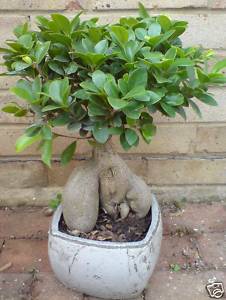
One of the attractions of this particular bonsai ficus ginseng is of course the roots which are usually exposed. Along with a thickish trunk and a canopy of dark green leaves it is a most attractive plant, creates a wonderful display in the home and is so easy to look after. This makes it ideal for newcomers to indoor plant keeping especially as it is very low maintenance.

Caring For The Bonsai Ficus Ginseng

Although the bonsai ficus ginseng can tolerate low light environments well, it does thrive much better in well lit environments and natural sunlight. So it is important to site the plant beside a window which receives lots of light for as much of the day as possible. I turn my own Ficus Ginseng by one quarter turn to the right each day so the whole ginseng plant has its fair share of the sun.

This bonsai tree does need a little tender loving care. It does need moderate watering in the winter, and I have had good results by feeding the potted soil with tomato plant liquid feed of all things. (Don't overdo this) Obviously, a little more water will be needed during the warmer summer season and less during the winter season.

The bonsai ficus ginseng does not mind being overwatered once in a while nor does it take offence when you forget to water it sometimes. It will however thrive more when misted regularly to mimic its rainforest home conditions. I do this daily using an old aerosol spray, and where possible I use rainwater rather than tap water which tends to contain Fluoride in this Country and I'm not sure this is good for the plant. Boiling tap water first may be another solution.

The bonsai ficus ginseng is basically a slow grower although this will depend on the condition of the plant and obviously on its environment. Repotting the bonsai plant depends on growth, so you may have to do this annually or bi-annually. I have had my ficus ginseng for about 6 months and growth is slow, so there is plenty of time to think about re-potting at a future time.

As for the soil, the plant does not seem too fussed and I have just used the soil which was in the pot when I bought the ginseng plant. Fertilizers may be added but the bonsai ficus ginseng is a good grower and can survive in lean conditions. (Try the tomato liquid fertilizer trick mentioned earlier)

The bonsai ficus ginseng tree is an easy tree to care for and you will not need to constantly monitor its state. At first you may be worried at the alarming habit the Ficus has of dropping its leaves daily. Look closely however at the plant and you will see that for all the dark green leaves which have been discarded, there will be a roughly equal number of light green new growth leaves to replace them.

The leaves of the bonsai ficus ginseng will need to be pinched when there are more than necessary to make a good looking crown. For every six new leaves that come out, you need to pinch off at least two or three to maintain its beauty and symmetry.

Overall the bonsai ficus ginseng is a hardy tree that is great for novices and beginners!

Wednesday, December 02, 2009

Ficus Ginseng Plant

Today i received a Ficus Ginseng plant as a gift and knowing very little about keeping them, I have started some basic research.

Apparently...

. A ficus bonsai tree may look good in your home but if you do not have the time and the patience to take care of it, you might as well forget the idea. You see, ficus bonsai trees are sensitive to changing environments and need constant attention. You need to tend to your tree every day to keep it healthy and beautiful. Therefore, busy people who keep erratic work and social schedules should not keep this type of plant at home.

. On the other hand, if you are one of those people who works a regular 9 to 5 job and then comes home to an empty house to eat dinner in the kitchen and then watch TV for the rest of the night, keeping a ficus bonsai plant is a good thing for you to do. Instead of wasting all your time sitting on the couch and watching TV when you get home, you can keep yourself busy tending to your bonsai tree. Tending to your bonsai tree is really a lot more relaxing and challenging than watching TV.

. Ficus will grow decently in low light, but thrive in high light conditions.

. Prune back to 2-4 leaves after 6-10 leaves have grown. use a dull pruning tool on Ficus, as a clean cut made by a sharp tool tends to bleed more than a dull cut.

. Water moderately, increasing in summer and decreasing in winter. Many Ficus are very tolerant of being over or under watered, which makes them ideal for beginners. The Ficus also enjoys a daily misting to maintain humidity.

. Repot every 2-3 years, although some will grow rapidly enough that yearly re-potting may be necessary. The best time is before a new growth spurt, especially in spring, but Ficus can literally be re-potted any time of year if reasonable after-care is given.

. Roots can easily be pruned by half. Basic bonsai soil is recommended, although Ficus tolerates many soil conditions.

All in all the ideal indoor companion without the need for walkies or a pooper scoop!

Terry Blackburn. Internet Marketing Consultant, living in South Shields in the North-East of England. Author and Producer of blog http://www.lawnsurgeon.blogspot.com. Author of "Your Perfect Lawn," a 90 Page eBook devoted to Lawn Preparation, Lawn Care and Maintenance. Find it at http://www.lawnsurgeon.com

I would be very interested to have your comments on this Article.

Article Source: http://EzineArticles.com/?expert=Terry_Blackburn

My Ficus Ginseng Plant!

My Ficus Ginseng Plant!
Cool or What?

Get Rid of Lawn Clover Video!

How to Create Good Growing Soil!