Thanks to Wikipedia for the following information on Ants.
"Modern society considers the ant a pest and due to the adaptive nature of ant colonies, eliminating them is nearly impossible. Pest control with regard to ants is more a matter of controlling local populations than eliminating an entire colony. Attempts to control ant populations of any kind are temporary solutions.
Typical ants that are classified as pests include pavement ants (otherwise known as the sugar ant), Pharaoh ants, carpenter ants, Argentine ants, and the red imported fire ant. Control of species populations are usually done with bait insecticides, which are either in the form of small granules, or as a sticky liquid that is gathered by the ants as food and then brought back to the nest where the poison is inadvertently spread to other members of the brood — a system that can severely reduce the numbers in a colony if used properly.
Boric acid and borax are often used as insecticides that are relatively safe for humans. With the recent insurgence of the red imported fire ant, a tactic called broadcast baiting has been employed, by which the substance (usually a granule bait designed specifically for fire ants) is spread across a large area, such as a lawn, in order to control populations. Nests may be destroyed by tracing the ants' trails back to the nest, then pouring boiling water into it to kill the queen. This works in about 60% of the mounds and needs about 14 litres (3 gallons) per mound.
Ants that tend other insects can indirectly cause pest infestations. Many homopteran insects that are considered as horticultural pests are controlled by the use of grease rings on the trunks of the trees. These rings cut off the routes for ants and make the pest species vulnerable to parasites and predators."
Showing posts with label hydrangea. Show all posts
Showing posts with label hydrangea. Show all posts
Saturday, September 01, 2007


Thursday, August 30, 2007
Clover!

So your Lawn is full of the dreaded Clover. Well did you know that until fairly recently, clover was not considered as a weed at all and indeed was liked by gardeners because it gave their Lawn a deeper green look.
This happens because Clover removes Nitrogen from the air and transfers it to your Lawn. In fact, some garden suppliers include Clover in their proprietory lawn mixes even today! It helps the grass grow more pest resistant, reduces the amount of fertilizer required, (so is good for the environment) and leaves the Lawn much healthier.
As a kid you probably went clover searching - looking for that one magical four-leaf charm. Seeing clover's shamrocks and little white or pink flowers in your lawn nowadays probably doesn't make you feel lucky anymore. Like many a perennial weed, clover can be hard to evict from your lawn.
As a result, it's one of the most common weeds around. Even though it's green and its flowers are, admit it, sort of cute, it attracts bees, which can be an underfoot danger, and is also quite slippery when wet, another danger.
So your probably asking what's the best method of Killing Clover In The Lawn?
The most effective method of controlling clover is to maintain a dense and healthy turf area. Often weeds can be easily kept out if the Ph and nutrients levels are optimum. Then a cornmeal application can be use to control the weeds. Use 10 pounds per 1,000 sq ft every 120 days simply as a fertilizer as well.
Mowing height and the frequency of mowing also will deter these weeds.
Clover does especially well in moist conditions and in less than optimally fertile soil. The one nutrient it really goes for is phosphorous.
So if you cut back on the water and up the level of the nutrients, other than phosphorous, that your lawn needs to thrive, your lawn will do better and weeds like clover will do worse. The best defense against any weed, clover included, is a healthy lawn.
Pulling weeds by hand also works in small lawns. Clover has a taproot you can easily dig out by hand. For spot control a little spade action is hard to beat.
In the last resort, chemical action is sometimes necessary, especially when managing large areas. Always read and follow directions on the label and keep pets and children away! Post-emergent herbicides do a great job on clover. A weed-and-feed that lists clover as among its targets will help tackle any serious clover encroachments.
Terry Blackburn. Internet Marketing Consultant, living in South Shields in the North-East of England. Author and Producer of blog http://www.lawnsurgeon.blogspot.com Author of "Your Perfect Lawn," a 90 Page eBook devoted to Lawn Preparation, Lawn Care and Maintenance. Find it at http://www.lawnsurgeon.com
I would be very interested to have your comments on this Article.
Wednesday, August 29, 2007
The Under-rated Hydrangea - hydrangea care!

One of the classic blue shrubs (in more acid soils) is the Hydrangea macrophylla, or common hydrangea. This has become almost a signature plant of gardens in the U.K. and it's easy to see why, because it provides endless Summer Hydrangea. Hardy and requiring little maintenance, it delivers year after year, over a long flowering period from midsummer to late autumn. Hydrangea macrophylla is in fact divided into two categories. The most frequently encountered are the 'mopheads' or 'Hortensias'. These are the ones producing big, confident, dome-shaped blooms. 'Blue Bonnet' or 'Goliath' are examples.
If you are looking for something more unusual, the 'Lacecap' hydrangeas provide an exciting alternative. The flowers of the lacecap hydrangeas are quite different from those of the mopheads. They are made up of two parts - an outer ring of showy florets and a central arrangement of small fertile flowers. Hydrangea 'Blaumeise' is a wonderful lacecap to look out for. Also known as 'Blue tit' or 'Blue sky' it produces exceptionally deep blue coloured flowers set against dark green leaves.
Another great choice if you're looking for blue flowering shrubs is the buddleia. Ideal in a border, the arching stems, tipped with clusters of flowers of varying shapes and colours (depending on species and variety) are, like the hydrangea, a classic sight in the summer garden. 'Black Knight' and 'Empire Blue' are examples of Buddleia davidii bearing flowers with blue and purple hues whicb are very attractive to butterflies. 'Lochinch' and 'West Hill' are other examples of bluish buddleia.
Lavender is a shade in its own right, and fields of the plant shimmering under a hot sun are an image to take home from Mediterranean holidays. Bring some of that romance into your garden with one of the hardy lavenders grown in this country. Lavenders will bring fragrance and colour to shrub borders or rock gardens. They can also be used to form a low hedge, perhaps around a vegetable area.
Three very different shrubs, all with the potential to bring the beauty of blue into the garden. As with many shrubs, none of these require much maintenance and will thrive in most garden soils (though for best blues from your hydrangeas your soil needs to tend towards acid). Blue can be bold or it can be demure. Either way it is always the height of good taste.
Subscribe to:
Posts (Atom)
My Ficus Ginseng Plant!
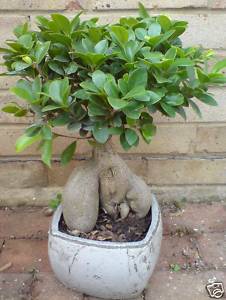
Cool or What?