Gardening with vinegar has many uses and benefits and best of all, it is safe to use, doesn't harm the environment, is freely available and it is cheap! It really is, therefore your organic and eco-friendly pesticide, insecticide, and herbicide.
Here you will learn about these benefits and pick up a few tips along the way. It can also be used full-strength or diluted depending on the job at hand. It can also be used quite readily in the kitchen, bathroom and other areas of the house, but today, we are going to just concentrate on the outside areas. One word of warning, however, remember that when it is all said and done, you are working with acid, so make sure you protect your eyes. So what exactly can vinegar do for you?
First of all, for those of you who are plagued by pests and little critters in the garden, fret no more. It will keep cats at bay if you spray in areas you want to deter them, particularly that sand-pit you may have in the garden for the children but those cats will insist on using as their own private toilet! Heavily spray full-strength vinegar around the edges of the sandpit and remember to re-apply after it rains.
Are those rabbits eating your vegetables, particularly your beans and peas? Soak corncobs in full strength vinegar for a couple of hours until they are thoroughly soaked. You may even soak them over-night if you wish. Then place the cobs strategically around your veggie patch. They will keep rabbits away for as long as you re-soak your corncobs every two weeks.
Do you have an ant problem? Again you can apply this full-strength to the ants and they will not come anywhere near the stuff. This is very useful if you find a trail of them making a way into your house. Just spray the thresholds and reapply every couple of days to ensure that they stay away.
Slugs are real pests, because they eat both vegetables, especially lettuces and plants, especially hostas. In this case, vinegar acts as a poison to the slugs because, if you spray slugs with it directly, they will die. You can treat snails in exactly the same way. However, because vinegar is also a herbicide, be careful where you spray your vinegar. Salvias for example will die, if they are sprayed as a casualty.
Are your fruit trees being invaded by fruit flies? Try this fruit fly bait, which is deadly and effective. Take 1 cup of water, a half a cup of cider vinegar, a quarter of a cup of sugar and 1 tablespoon of molasses. Mix it all together. Take old tin cans without their lids and make two holes in opposite ends for wire handles. Attach the handles and add an inch of the mixture to each can. Hang 2 - 3 tins in each tree. Check on the traps on a regular basis to refill and clean when necessary.
After you have been digging in the garden with your gardening tools, soak them in a bucket of half-strength vinegar. This will act as a fungicide and kill off anything that may be lurking unsuspectingly so that there is no possibility of cross-contamination when you use them next.
Are your garden plants struggling and your roses suffering from black spot or other fungal diseases? Take 2 tablespoons of white vinegar and mix it with 4 litres of compost tea. Now spray your garden plants with this mixture and see the difference. For roses, the method is slightly different. Take 3 tablespoons of cider vinegar, and mix it with 4 litres of water to control those fungal diseases. Of course, don't forget the compost tea either on your roses to get the best results. For powdery mildew take 2-3 tablespoons of cider vinegar and mix with 4 litres of water and spray your plants. This will help control the problem.
What about your acid-living plants like azaleas, gardenias and rhododendrons? Are they flowering as well as they could be? If not, increase the soil's acidity. In hard water areas, add 1 cup of vinegar to 4 litres of tap water. It will also release iron into the soil for the plants to use. And if you have too much lime in your garden, add vinegar to neutralize it.
Do you have weeds coming up in between your paving slabs on our driveway or pathway that you cannot remove by hand? Don't use a herbicide that is know to damage the environment. Use an eco-friendly alternative instead. Take 1 litre of boiled water, 2 tablespoons of salt and 5 tablespoons of vinegar. Mix altogether, and whilst still hot, pour onto the offending plants.
Did you know that you can improve your germination success rate of seeds by using vinegar? This is especially useful for those seeds that are more difficult to germinate such as asparagus and okra, morning glories and moonflowers. Rub the seeds gently first between two pieces of coarse sandpaper. Then soak the seeds overnight in 500 ml of warm water, 125 ml of vinegar and a squirt of washing-up liquid. Plant the next day as normal. You can use the same method, but without the sandpaper for nasturtiums, parsley, beetroot, and parsnips.
And finally, are your chickens pecking each other? Add a tablespoon of cider vinegar to their drinking water, and they will stop!
Written by Kathryn Bax, owner and web site developer of Country Living and Farm Lifestyles: A Worldwide Farmers' Market for Farm Food, Farm Accommodation, Game Farms, Wine Farms, Farming Jobs, Farm Swaps, Rural Services, Country Living and much, much more. Buy local and support your local farmers.
http://www.countryfarm-lifestyles.com/
Showing posts with label cats. Show all posts
Showing posts with label cats. Show all posts
Saturday, November 29, 2008


Sunday, September 09, 2007
Key Gardening Jobs for Autumn!
Well, the nights are drawing in here in England and there is a slight chill in the air. September is here and Autumn is upon us once more. I thought this "To Do" list
might help in jogging a few memories of things to do around the garden at this time of year.
Early Autumn
. Bring in tender plants under cover before the first frosts
. Plant or move evergreens and conifers, while the soil is still warm
. Plant spring bedding, such as wallflowers and polyanthus
. Plant spring bulbs
Mid Autumn
. Tidy perennials, removing dead stems but leaving seed-heads for birds to eat
. Plant deciduous trees, shrubs and climbers
. Lay new lawns, so long as soil is not too wet
. Batten down the hatches, ensuring nothing can blow about and cause damage on windy nights.
Late Autumn
. Plant shrubs, roses and hedging plants sold with bare roots
. Clear up fallen leaves and compost them
. Plant tulips and hyacinths
. Move deciduous trees and shrubs once they have lost their leaves
. Take hardwood cuttings from shrubs and roses
Tuesday, September 04, 2007
How to Keep Cats Out of Your Garden!
Do cat repellents work? How do I stop cats from using my garden as a toilet? How can I keep cats out of my garden? These are among the most frequently asked questions by gardeners everywhere.
The first line of defence should be to ensure that your garden boundaries are secure. Any gaps in your fence should be blocked to deny low level access. Cats however can jump rather well and rather high, so fix a taut wire or string some six inches above the top of your fence to deter this approach.
Once inside your garden many people say that the best cat repellent is a dog who will soon see off any feline invader. That pre-supposes that you are a dog lover. If not, then you will have to resort to more passive methods. For example, cats like to lie on freshly dug soil, so you should lay mulch on your borders so that no bare soil is left exposed. Seed beds should be covered with wire netting or twigs arranged as a barrier.
Young trees should have plastic guards fitted around their trunks to protect them against use as a scratching pole. Your garden pond should be covered with netting to keep your fish safe.
Cats are generally known to dislike water, so a well aimed bucketful or a squirt with the hose will certainly make an intruder run. After one or two dousings it may learn the lesson and stay away.
To protect plants and borders, both mothballs and citrus are said to be effective deterrents. Place the mothballs, orange peel or lemon rind in the borders. Alternatively spray cloths with orange scented air freshener and place the cloths around the plants you wish to protect. Other known cat repellents are cayenne pepper, coffee grounds, pipe tobacco, lavender oil, lemon grass oil, citronella oil, eucalyptus oil and mustard oil.
Certain herbs are said to deter cats. In particular rue but not catmint which has the opposite effect. Coleus canina is another plant which is marketed by one merchant as a cat repellent.
If you visit your local garden center or hardware store you will find several cat repellent products on sale. These range from electric water sprinklers and ultrasonic devices to sprays and granules.
Motion activated sprinklers act in the same way as a burglar alarm using an infra red detector. When the cat enters the area covered by the detector the sprinkler shoots out a jet of water to scare the animal away. It is claimed that, after one or two encounters with the jet, the cat will learn to avoid the area.
Ultrasonic devices emit a high frequency sound which is annoying to cats (and dogs) but is not audible to humans. There are various different models some of which operate continuously and others which have an infra red detector and only emit a pulse of sound when the cat triggers the device. To be successful you need to ensure that the model is powerful enough to cover the area you wish to protect. In addition make sure that the sound frequency is designed for larger animals since some models are intended to deter insects and so would be no use for cats.
There are also commercial scent cat repellents. Those that use chemicals should be kept away from any food crops but the essential oil based granule varieties act in the same way as orange and lemon peel mentioned above. Another way to keep a cat out if the garden is a repellent evaporator which consists of a container holding puffed rice which has been impregnated with essential oils. These are effective for three to four weeks and can then be refilled for a further period. Another natural product which many people claim really keeps a cat out of the garden is lion's dung. You may need to visit your local zoo to obtain this although some stores do stock zoo poo.
In Ontario, Canada the local township provides a cat trap service. Once the animal enters the cage it cannot escape but is completely unharmed. The owner has to pay to recover his pet and so should be encouraged not to let the cat stray in future. Apparently few owners bother to reclaim their cats but just obtain another kitten. However this sounds like a good way of dealing with a cat that cannot be deterred by any other method. If there is no such scheme in your area, just buy your own trap.
So, to recap, the first priority is to secure your boundary fences. Then you have the whole selection of suggested cat repellents ranging from homemade recipes to expensive commercial gadgets. I would suggest that you try the orange peel and prickly twigs for a start. If you are around when the intruder appears, try the bucket of water or hose. Even if you miss, the shock may be a sufficient deterrent. If these do not do the trick, then you may have to consider the commercial alternatives.
With thanks for this Article by Hugh Harris-Evans at http://members.ezinearticles.com/index.php
Thursday, August 30, 2007
Dandelion!

Dandelion! The Ultimate Weed!
Some people like the sight of yellow dandelion flowers in their lawn. Others may even appreciate their skyward-stretching puffballs. But if you're not one of those people, we can suggest some natural and organic methods for controlling dandelions.
Pulling dandelions by hand is not that easy, but it can be done. You need to get the whole tap root out—if you don't, the piece you've left in the ground will sprout new foliage and, eventually, yellow flowers and white puffballs.
For little weeds, pulling the tap root out is not too hard if you're careful. For larger specimens, it can be nearly impossible. A special "dandelion digger" tool can help, as can attempting your weed-pulling operation after it's rained, when the ground it still a little loose.
Dandelions grow in one of two ways; from a dandelion seed that germinates, or from a still-viable piece of tap root that's under the surface. If you can interrupt the seed production cycle AND starve the tap roots of nutrients, you can defeat your lawn's dandelions without having to buy any chemicals or other products. Here's how to approach this:
1. Pick off the Heads — As soon as you see a dandelion plant's yellow flowers, pick the heads off. That will prevent them from getting to the puffball stage, when they release the seeds for the next generation of your lawn's worst nightmare.
2. Pick off the Leaves — Picking the leaves off a dandelion will not kill it because the tap root remains below the surface and will quickly send up new leaves. But repeatedly picking off the leaves will eventually starve the tap root of nutrients and kill the weed.
3. Corn gluten meal—which, just like it sounds, is naturally derived from corn. It acts by suppressing the germination process of a variety of weed seeds, including crabgrass and dandelion.
A multi-year program of applying corn gluten meal every spring will eventually give you a weed-free lawn. Remember that corn gluten meal will suppress germination of grass seeds as well, so time your applications away from reseedings.
The only other downside of corn gluten meal is that it will also kill the beneficial, nitrogen-fixing clover in your lawn, but we recognize that from some people's perspectives, that's a good thing.
Corn gluten meal also benefits your grass by adding nitrogen to the soil.
If you like spending money on mechanical gadgets to help you with your gardening, you'll find a variety of appliances such as flame weeders, mechanical pullers, water-powered weeders, and heat zappers, all designed to kill your dandelions off. These do work but are expensive.
Subscribe to:
Posts (Atom)
My Ficus Ginseng Plant!
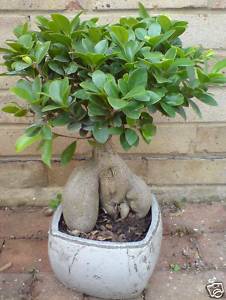
Cool or What?