Gardening with vinegar has many uses and benefits and best of all, it is safe to use, doesn't harm the environment, is freely available and it is cheap! It really is, therefore your organic and eco-friendly pesticide, insecticide, and herbicide.
Here you will learn about these benefits and pick up a few tips along the way. It can also be used full-strength or diluted depending on the job at hand. It can also be used quite readily in the kitchen, bathroom and other areas of the house, but today, we are going to just concentrate on the outside areas. One word of warning, however, remember that when it is all said and done, you are working with acid, so make sure you protect your eyes. So what exactly can vinegar do for you?
First of all, for those of you who are plagued by pests and little critters in the garden, fret no more. It will keep cats at bay if you spray in areas you want to deter them, particularly that sand-pit you may have in the garden for the children but those cats will insist on using as their own private toilet! Heavily spray full-strength vinegar around the edges of the sandpit and remember to re-apply after it rains.
Are those rabbits eating your vegetables, particularly your beans and peas? Soak corncobs in full strength vinegar for a couple of hours until they are thoroughly soaked. You may even soak them over-night if you wish. Then place the cobs strategically around your veggie patch. They will keep rabbits away for as long as you re-soak your corncobs every two weeks.
Do you have an ant problem? Again you can apply this full-strength to the ants and they will not come anywhere near the stuff. This is very useful if you find a trail of them making a way into your house. Just spray the thresholds and reapply every couple of days to ensure that they stay away.
Slugs are real pests, because they eat both vegetables, especially lettuces and plants, especially hostas. In this case, vinegar acts as a poison to the slugs because, if you spray slugs with it directly, they will die. You can treat snails in exactly the same way. However, because vinegar is also a herbicide, be careful where you spray your vinegar. Salvias for example will die, if they are sprayed as a casualty.
Are your fruit trees being invaded by fruit flies? Try this fruit fly bait, which is deadly and effective. Take 1 cup of water, a half a cup of cider vinegar, a quarter of a cup of sugar and 1 tablespoon of molasses. Mix it all together. Take old tin cans without their lids and make two holes in opposite ends for wire handles. Attach the handles and add an inch of the mixture to each can. Hang 2 - 3 tins in each tree. Check on the traps on a regular basis to refill and clean when necessary.
After you have been digging in the garden with your gardening tools, soak them in a bucket of half-strength vinegar. This will act as a fungicide and kill off anything that may be lurking unsuspectingly so that there is no possibility of cross-contamination when you use them next.
Are your garden plants struggling and your roses suffering from black spot or other fungal diseases? Take 2 tablespoons of white vinegar and mix it with 4 litres of compost tea. Now spray your garden plants with this mixture and see the difference. For roses, the method is slightly different. Take 3 tablespoons of cider vinegar, and mix it with 4 litres of water to control those fungal diseases. Of course, don't forget the compost tea either on your roses to get the best results. For powdery mildew take 2-3 tablespoons of cider vinegar and mix with 4 litres of water and spray your plants. This will help control the problem.
What about your acid-living plants like azaleas, gardenias and rhododendrons? Are they flowering as well as they could be? If not, increase the soil's acidity. In hard water areas, add 1 cup of vinegar to 4 litres of tap water. It will also release iron into the soil for the plants to use. And if you have too much lime in your garden, add vinegar to neutralize it.
Do you have weeds coming up in between your paving slabs on our driveway or pathway that you cannot remove by hand? Don't use a herbicide that is know to damage the environment. Use an eco-friendly alternative instead. Take 1 litre of boiled water, 2 tablespoons of salt and 5 tablespoons of vinegar. Mix altogether, and whilst still hot, pour onto the offending plants.
Did you know that you can improve your germination success rate of seeds by using vinegar? This is especially useful for those seeds that are more difficult to germinate such as asparagus and okra, morning glories and moonflowers. Rub the seeds gently first between two pieces of coarse sandpaper. Then soak the seeds overnight in 500 ml of warm water, 125 ml of vinegar and a squirt of washing-up liquid. Plant the next day as normal. You can use the same method, but without the sandpaper for nasturtiums, parsley, beetroot, and parsnips.
And finally, are your chickens pecking each other? Add a tablespoon of cider vinegar to their drinking water, and they will stop!
Written by Kathryn Bax, owner and web site developer of Country Living and Farm Lifestyles: A Worldwide Farmers' Market for Farm Food, Farm Accommodation, Game Farms, Wine Farms, Farming Jobs, Farm Swaps, Rural Services, Country Living and much, much more. Buy local and support your local farmers.
http://www.countryfarm-lifestyles.com/
Saturday, November 29, 2008


Sunday, November 02, 2008
Diary of a Silver Surfer
Hi again folks.......well did you miss me? the story is that when I set this Blog up i was officially retired.
Sadly, with the recent financial chaos, i had to go back to work to earn a crust and pay the mortgage! Result .... one 66 year old working 11 hour shifts in a Call Centre to supplement a pathetic State Pension.
Give me strength. we are over taxed, overlooked, over bureaucratised, spied on, treble taxed, and our opinions trodden underfoot.
And don't tell me this is a Democracy -- you can just vote them out. Do me a favour. Do you honestly believe things will change under a different Government?
My friend Democracy is dead in U.K. The idea that an Englishman's home is his castle has disappeared for ever. Have you any idea how many faceless people can invade your home without a warrant?
Do you know how many "refugees" are living among us sucking the life blood out of the State Benefit System I paid into for 50 years and which has singularly failed to
keep its promise to me and people of my generation.
I have thought hard about this and have decided to re-start my gardening Blog today. With a cutting edge of comment added to it.
In fact, I may even start a new Blog or Newsletter for Silver surfers like me who want to be heard by an unelected unrepresentative bunch of crooks called politicians,
whose noses are stuck so firmly in the trough that they breath through their backsides and can't see the real World at all!
And don't get me started about the EC. I'll keep that one for another day.
Meantime, if there is anyone out there reading this who feels like me and wants to vent their frustration drop a comment on this article and i will get back to you.
On gardening issues, here is an article you may be interested in provided by our friends at http://www.tipsonflowergardening.com/winter-flowers.html
"Quick. Name 10 winter flowers....!
Yes, I know, it depends where you live. For instance, if you look out your window and see snow drifts big enough to hide a dog, you will have to settle for indoor winter flowers. But if you live in a zone that allows outdoor plants to bloom year round, then here are some gorgeous winter flowers.
Witch hazel (Hamamelis spp.) is a winter-flowering shrub. These shrubs can grow to a height of 20 feet and they bloom from late fall through the winter. The Hamamelis virginiana variety is native to North America and has yellow-gold flowers and leaves. Yes, the astringent witch hazel comes from this plant but it offers great winter color.
Japanese pieris (Pieris japonica) is another shrub that blooms in winter. The blooms are strands of buds in bright red, white or pink. The leaves are bright green.
Christmas roses (or Lenton roses) (Helleborus spp.) bloom in mid to late winter. They have dark green leaves and cup-shaped blooms in maroon, pink, white or red. As the bloom get older, they fade to a creamy ivory color.
Glory-of-the-snow (Chionodoxa lucillae) provides star-shaped flowers. This plant grows from bulbs and there is a trick to keeping it blooming year after year. After the blooms stop, don’t mow the lawn for six week. This lets the bulbs pull the necessary energy from the lawn so that it can bloom again next winter.
Winter Jasmine (Jasminum nudiflorum) is a shrub with yellow jasmine blossoms that bloom from late fall and the winter. It can grow to a height of 15 feet and makes a great trellis-trained plant.
Firethorn (Pyracantha) is a good companion winter flower for the winter jasmine. It grows berries in bright red or pale yellow. Don’t prune it because this will trim off the potential berries.
There are early bulbs that qualify as winter flowers because given the right circumstances, they will blossom early enough to be in your garden when the snow is still there. Some of the favorite early blooming bulbs are crocus, amaryllis, hyacinth, tulip, and narcissus. A couple of other contenders are snowdrops (Galanthus nivalis) and the reticulated iris (Iris reticulata).
What you need to remember about winter flowers is that they are not going to be great big beds of various colorful flowers. Technically most of them are shrubs. You can check to see which ones will flourish in your area and try one or two. Even bright shiny green leaves in February can be quite attractive."
Sadly, with the recent financial chaos, i had to go back to work to earn a crust and pay the mortgage! Result .... one 66 year old working 11 hour shifts in a Call Centre to supplement a pathetic State Pension.
Give me strength. we are over taxed, overlooked, over bureaucratised, spied on, treble taxed, and our opinions trodden underfoot.
And don't tell me this is a Democracy -- you can just vote them out. Do me a favour. Do you honestly believe things will change under a different Government?
My friend Democracy is dead in U.K. The idea that an Englishman's home is his castle has disappeared for ever. Have you any idea how many faceless people can invade your home without a warrant?
Do you know how many "refugees" are living among us sucking the life blood out of the State Benefit System I paid into for 50 years and which has singularly failed to
keep its promise to me and people of my generation.
I have thought hard about this and have decided to re-start my gardening Blog today. With a cutting edge of comment added to it.
In fact, I may even start a new Blog or Newsletter for Silver surfers like me who want to be heard by an unelected unrepresentative bunch of crooks called politicians,
whose noses are stuck so firmly in the trough that they breath through their backsides and can't see the real World at all!
And don't get me started about the EC. I'll keep that one for another day.
Meantime, if there is anyone out there reading this who feels like me and wants to vent their frustration drop a comment on this article and i will get back to you.
On gardening issues, here is an article you may be interested in provided by our friends at http://www.tipsonflowergardening.com/winter-flowers.html
"Quick. Name 10 winter flowers....!
Yes, I know, it depends where you live. For instance, if you look out your window and see snow drifts big enough to hide a dog, you will have to settle for indoor winter flowers. But if you live in a zone that allows outdoor plants to bloom year round, then here are some gorgeous winter flowers.
Witch hazel (Hamamelis spp.) is a winter-flowering shrub. These shrubs can grow to a height of 20 feet and they bloom from late fall through the winter. The Hamamelis virginiana variety is native to North America and has yellow-gold flowers and leaves. Yes, the astringent witch hazel comes from this plant but it offers great winter color.
Japanese pieris (Pieris japonica) is another shrub that blooms in winter. The blooms are strands of buds in bright red, white or pink. The leaves are bright green.
Christmas roses (or Lenton roses) (Helleborus spp.) bloom in mid to late winter. They have dark green leaves and cup-shaped blooms in maroon, pink, white or red. As the bloom get older, they fade to a creamy ivory color.
Glory-of-the-snow (Chionodoxa lucillae) provides star-shaped flowers. This plant grows from bulbs and there is a trick to keeping it blooming year after year. After the blooms stop, don’t mow the lawn for six week. This lets the bulbs pull the necessary energy from the lawn so that it can bloom again next winter.
Winter Jasmine (Jasminum nudiflorum) is a shrub with yellow jasmine blossoms that bloom from late fall and the winter. It can grow to a height of 15 feet and makes a great trellis-trained plant.
Firethorn (Pyracantha) is a good companion winter flower for the winter jasmine. It grows berries in bright red or pale yellow. Don’t prune it because this will trim off the potential berries.
There are early bulbs that qualify as winter flowers because given the right circumstances, they will blossom early enough to be in your garden when the snow is still there. Some of the favorite early blooming bulbs are crocus, amaryllis, hyacinth, tulip, and narcissus. A couple of other contenders are snowdrops (Galanthus nivalis) and the reticulated iris (Iris reticulata).
What you need to remember about winter flowers is that they are not going to be great big beds of various colorful flowers. Technically most of them are shrubs. You can check to see which ones will flourish in your area and try one or two. Even bright shiny green leaves in February can be quite attractive."
Subscribe to:
Posts (Atom)
My Ficus Ginseng Plant!
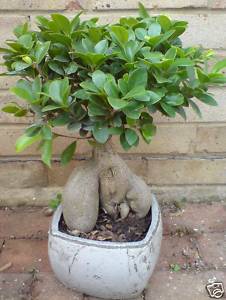
Cool or What?